Research
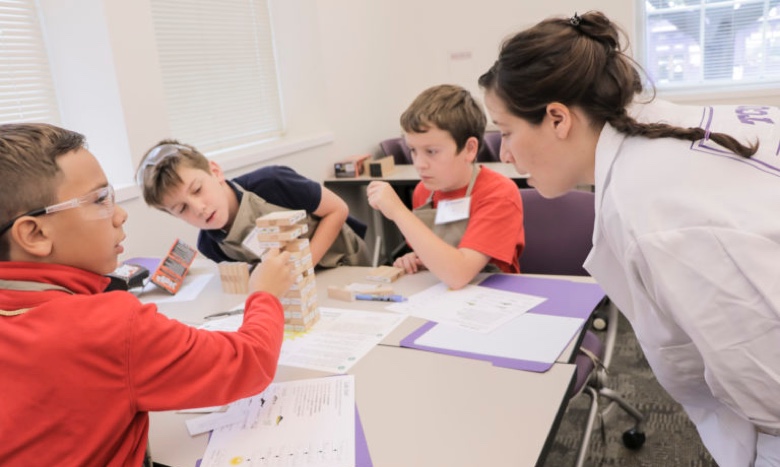
The Andrews Institute for Research in Mathematics & Science Education is committed to a cycle of teaching and learning in which teachers, students and university faculty learn new information about best practices in teaching mathematics and science. This involves cutting-edge, interdisciplinary research as well outreach to the community. In support of the TCU Strategic Pillar #2 of " Research, Scholarship, and Creative Activity" and the College of Education Strategic Priority of "Scholarship and Research", the Andrews Institute provides a research venue in which: a) exchange of alternative ideas is fostered, b) laboratory space for piloting innovations is provided, and c) undergraduate and graduate students as co-researchers with faculty is expected.
Faculty are active in the pursuit of external funding for research. Current funding includes:
- JAMP. "A retrospective analysis of predictors of students success in the Joint Admissions Mdical Program". PI - Matt Chumchal, CO-PI- Molly Weinburgh and Nelis Potgieter, $999,000.00 January 2026 - December 2026.
- META. “Summer programing for Youth”. PI-Molly Weinburgh, $25,000.00 March 2025- March 2026
- NSF. “Teachers’ effectiveness and retention during the COVID-19 pandemic”. PI: Molly Weinburgh; Co: PIs – Dean Williams and Melissa Demetrikopoulos. NSF#2243392 $999,980.00 March 2023- February 2027
- NSF. “Collaborative Research: Expanding Socio-Environmental Science Investigations with Geospatial Technologies in High Schools”. PI – Tom Hammond (Lehigh University), PI – Judith Morrison (Washington State University), and PI – Curby Alexander (TCU) with Molly Weinburgh (TCU senior personnel). NSF #1949393 $3,000,000.00 overall. May 2020 – May 2026.
Interdisciplilnary teams of faculty, graduate students, and undergraduate students investigate areas of interest in mathematics and science. Currently topics being examined include:
- Mentoring [Medical student to pre-medical student; Pre-health students to middle school students]
- Women in Science Education (WISE): Experiences as faculty
- Science and science teacher identity formation
- Modeling as an effective teaching practice
- Learning progressions in science
- Impact of COVID-19 on STEM teacher effectiveness and retention
- Representations of variables
- Early algebraic understanding
- Classroom discourse in mathematics
- Pre-service teacher education in mathematics and science education
- In-service science teacher professional development
- Equity issues in access to science (foci on language development)